
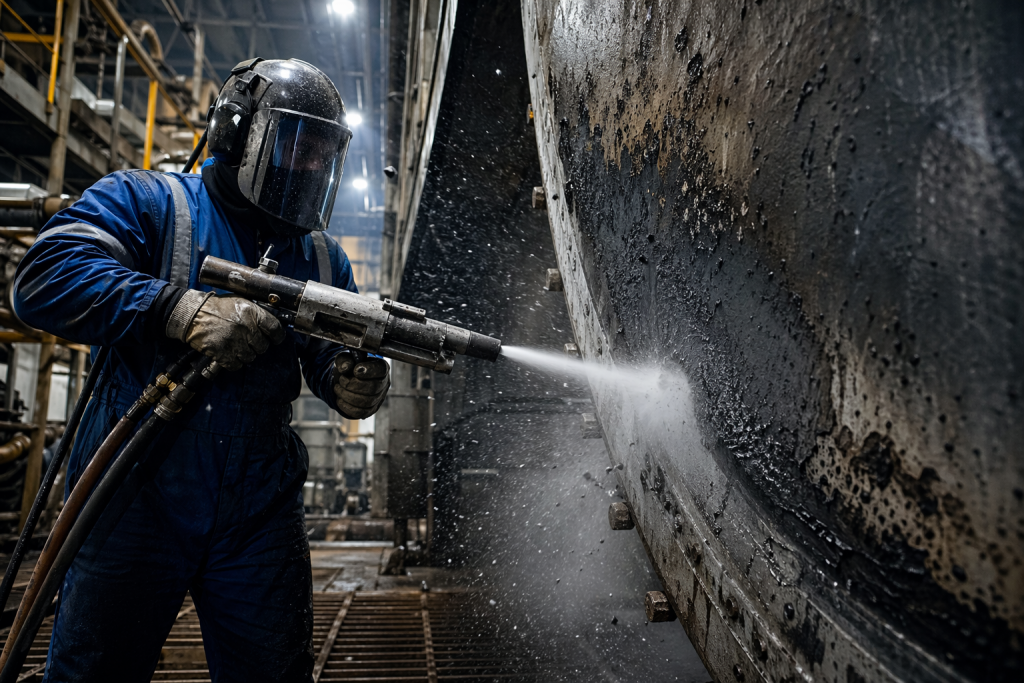
There are situations where a mop, a pressure washer, or a standard cleaning crew simply cannot get the job done. For example, grease baked onto industrial equipment, mold embedded in structural materials, and fire residue coating every surface are problems that demand a smarter approach. Top of the Line Services LTD understands this reality, and that is exactly why industrial dry ice blasting has become one of the most sought-after solutions for clients across Calgary and beyond. As a result, when conventional methods fall short, this technology steps in and delivers results that nothing else can match.
Why Conventional Cleaning Methods Hit a Wall
Traditional cleaning relies on water, chemicals, abrasives, or manual scrubbing. However, each of these approaches carries significant limitations. For instance, water can damage electrical components and promote mold growth if surfaces stay wet. Similarly, chemicals introduce hazardous residues and require careful disposal. In addition, abrasive blasting strips coatings and can damage delicate surfaces. Meanwhile, manual scrubbing is slow, costly, and rarely thorough enough for industrial-scale contamination.
These limitations become critical problems in high-stakes environments. For example, a food processing plant cannot afford chemical contamination. Likewise, a fire-damaged home cannot take on more moisture. Furthermore, an industrial facility cannot shut down for days while crews scrub equipment by hand. As a result, clients in these situations need a method that is fast, effective, and safe for both people and surfaces.
What Makes Industrial Dry Ice Blasting Different
Industrial dry ice blasting uses solid CO2 pellets fired at high velocity through a pressurized stream. When the pellets hit a contaminated surface, three things happen simultaneously.
First, the kinetic impact loosens contaminants from the surface. Second, the extreme cold — dry ice sits at approximately -78.5°C — causes a thermal shock that makes most substances brittle and easy to remove. Third, and perhaps most importantly, the pellets sublimate instantly upon impact, meaning they turn directly from solid to gas. Therefore, they leave no secondary waste behind.
This combination makes dry ice blasting uniquely effective. Specifically, it is non-abrasive, so it does not damage the underlying material. It is also dry, so moisture-sensitive equipment stays safe. Moreover, it requires no chemical agents, meaning there is no residue, no disposal problem, and no risk of contaminating food, pharmaceuticals, or sensitive environments.
As a result, the process delivers a deep, thorough clean that reaches into crevices and contours that brushes and cloths simply cannot access.
Where This Technology Delivers the Most Value
Industrial dry ice blasting works across a remarkable range of applications. Consequently, understanding where it performs best helps clients recognize when to call in this solution rather than defaulting to traditional methods.
Fire and Smoke Damage Restoration
After a fire, soot and smoke residue penetrate deeply into walls, ceilings, ductwork, and structural beams. In contrast to standard cleaning, dry ice blasting reaches into every layer and removes the residue without adding moisture to already-stressed materials. Furthermore, paired with a professional fire and smoke restoration service, it produces a level of cleanup that protects air quality and prevents long-term odor problems.
Industrial Equipment and Machinery
Manufacturing equipment accumulates grease, carbon buildup, and production residue over time. As a result, shutting down machinery for lengthy cleaning cycles becomes extremely expensive. Fortunately, dry ice blasting cuts cleaning time dramatically. In many cases, it cleans equipment in place without requiring full disassembly. In addition, the process is safe for motors, wiring, and precision components.
Mold Remediation
Mold removal is one of the most challenging cleaning tasks in any structure. This is because mold grows into surfaces rather than sitting on top of them. Nevertheless, dry ice blasting removes mold spores and organic material at the surface level with precision. Unlike sanding or scrubbing, it does not spread spores into the surrounding area. When mold has reached attic materials or insulation systems, it often makes sense to consider attic insulation removal in Calgary alongside the blasting process to eliminate contamination completely.
Biohazard and Trauma Scene Cleanup
Some cleaning situations involve biological contamination that puts workers and occupants at serious risk. In these cases, industrial dry ice blasting supports biohazard cleanup in Calgary by decontaminating hard surfaces rapidly. Moreover, it works without chemical agents that could react unpredictably with biological material. As a result, the non-porous surfaces in these environments respond exceptionally well to the process.
Pre-Demolition and Post-Demolition Cleaning
Before a demolition project begins, surfaces sometimes need decontamination to protect workers and comply with regulations. Similarly, after demolition, residual material on retained structures needs thorough removal. For this reason, professional demolition services in Calgary increasingly incorporate dry ice blasting into both the preparation and cleanup phases.
The Safety and Environmental Advantage
Industrial dry ice blasting is one of the most environmentally responsible cleaning methods available. To begin with, CO2 used for this process is captured as a byproduct of other industrial processes, so it does not add new carbon to the atmosphere. Furthermore, the process generates no secondary waste stream. As a result, workers are not exposed to harsh solvents, and surrounding areas are not contaminated by runoff or chemical drift.
For industries operating under strict environmental and safety standards — such as food production, pharmaceuticals, healthcare facilities, and public infrastructure — this matters enormously. In fact, compliance is not an afterthought. Instead, it is built directly into the method itself.
What to Expect From a Professional Application
Choosing industrial dry ice blasting means working with trained technicians who understand both the equipment and the environment they are working in. To start, the setup is straightforward. Equipment arrives on-site, connects to a compressed air source, and technicians begin working with precision. In most cases, projects move significantly faster than traditional cleaning approaches.
Additionally, technicians adjust pellet size, pressure, and distance based on the surface and contamination type. For instance, delicate historical materials need a different approach than a steel industrial frame. Consequently, this adaptability is one of the key advantages of the technology — it scales precisely to the task at hand.
Top of the Line Services LTD works across a wide range of industries and site conditions. Whether the job involves a commercial kitchen, an industrial plant, a fire-damaged residence, or a contaminated structure awaiting remediation, the process adapts to deliver consistent, measurable results.
When to Make the Call
If a cleaning job has already failed using traditional methods, then industrial dry ice blasting is the next logical step. It is also worth considering at the outset for any project involving fire damage, heavy industrial contamination, mold, biological hazards, or moisture-sensitive equipment.
Furthermore, waiting too long increases the cost of remediation. Over time, contamination spreads, mold grows deeper into materials, and residue bonds more firmly to surfaces. Therefore, acting quickly with the right method protects both the structure and the budget.
Top of the Line Services LTD brings the expertise, equipment, and experience to assess each situation carefully. As a result, industrial dry ice blasting is applied where it will deliver the greatest impact. When the standard approach is not enough, this is the method that changes the outcome.
For clients evaluating their options, a consultation is always the best starting point. Experienced technicians can assess the site, explain the process, and outline what results are realistic. The technology works consistently. The question is simply whether it is the right fit for a given project — and in most difficult cleaning scenarios, it clearly is.
In conclusion, when traditional methods have failed or simply are not up to the task, dry ice blasting in Calgary delivers the kind of results that redefine what clean actually means. Top of the Line Services LTD is ready to put that technology to work.
Frequently Asked Questions
1. Is industrial dry ice blasting safe for sensitive equipment? Yes. Because dry ice blasting is non-abrasive and leaves no moisture or chemical residue, it is safe for motors, electrical components, precision machinery, and delicate surfaces. Furthermore, technicians adjust settings based on the specific equipment involved.
2. How long does a typical dry ice blasting job take? Project duration depends on the size of the area and the type of contamination. However, most industrial dry ice blasting jobs are completed significantly faster than traditional cleaning methods. In many cases, equipment cleaning tasks are finished in hours rather than days.
3. Does dry ice blasting remove mold permanently? Dry ice blasting removes mold spores and organic material from surfaces with high precision. However, permanent mold control also requires addressing the underlying moisture source. Therefore, blasting is most effective as part of a complete remediation plan.
4. Is the process environmentally harmful? No. The CO2 used for dry ice blasting is captured from existing industrial processes and does not add new emissions. As a result, the process generates no secondary waste, no chemical runoff, and no hazardous byproducts. It is consequently one of the most environmentally responsible industrial cleaning methods available.
5. What industries benefit most from dry ice blasting? Food processing, manufacturing, fire restoration, mold remediation, healthcare, pharmaceutical production, and construction are among the sectors that benefit most. In particular, any environment where chemical residues, moisture, or abrasive damage would create problems is a strong candidate for industrial dry ice blasting.